
COACH IN FOCUS - Tim Stegmann (English version below)

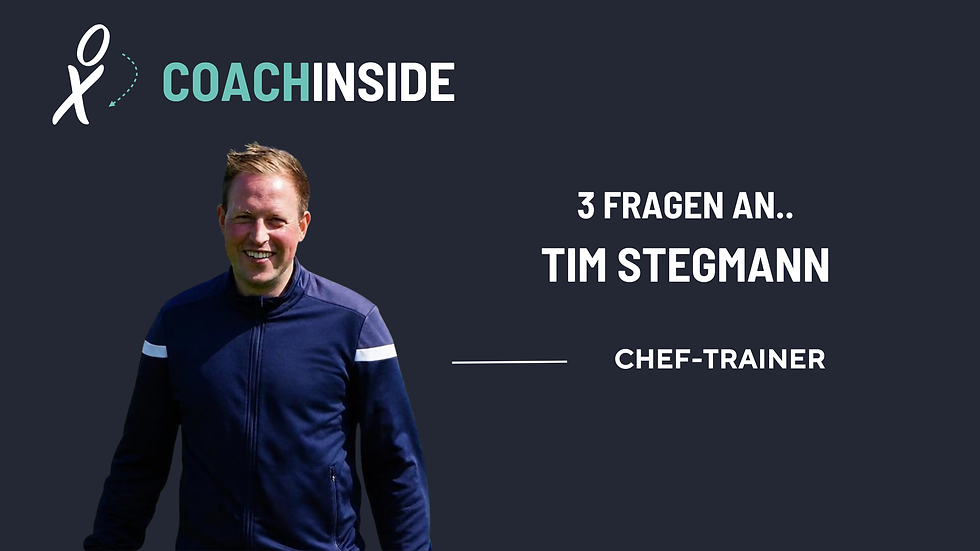
Tim Stegmann begann seinen Trainerweg im Nachwuchsleistungsbereich. Sechs Jahre arbeitete er beim VfL Wolfsburg, unter anderem als Co-Trainer der U17 und U19 sowie als Koordinator und Scout. Über die Würzburger Kickers führte sein Weg 2019 zum Hamburger Fußball-Verband, wo er als Verbandssportlehrer Auswahlmannschaften betreute. Stegmann verfügt über die UEFA-A-Lizenz sowie zwei Masterabschlüsse aus Spanien: den „Master en Dirección de Fútbol“ an der Universidad Europea de Madrid und den Master „Fútbol Profesional“ in Barcelona. Ergänzend absolvierte er einen Master in Tactical Periodization nach Vítor Frade. Zudem ist er Autor des Buches „Xabi Campeón“ über die Spielidee und Entwicklung von Xabi Alonso.
Im Interview spricht Stegmann darüber, wie er Trainingswochen im Auswahlbereich mit wenig Zeit und wechselnden Gruppen plant und warum für ihn dabei „weniger ist mehr“ gilt. Er erklärt, welche Rolle die Taktische Periodisierung bei Belastungssteuerung und Verfügbarkeit spielt, wie Spieler innerhalb eines klaren Rahmens eigene Lösungen entwickeln und wie aus einer neu zusammengestellten Gruppe ein Team entsteht. Außerdem geht es um die Bedeutung von Persönlichkeit und gemeinsamen Standards sowie um COACHINSIDE als Plattform, um seine Arbeitsweise sichtbar zu machen.
Als Verbandssportlehrer beim Hamburger Fußball-Verband hast du mit deinen Auswahlmannschaften meist einmal pro Woche trainiert. Mehrere Tage am Stück, also zwei bis drei, gab es nur vor Turnieren. Wie plant man mit so wenig gemeinsamer Zeit anders als im Vereinsalltag? Was war der erste Baustein, den du gesetzt hast, wenn eine Gruppe neu zusammenkam? Welche Prinzipien waren für dich nicht verhandelbar, und was hast du bewusst offen gelassen, damit die Spieler eigene Lösungen finden?
Tim Stegmann: Grundsätzlich ist die Möglichkeit, mit einer Auswahlmannschaft beinahe wöchentlich arbeiten zu können, im Verbandskontext ein Luxus. Gleichzeitig sind aufgrund von vielen unterschiedlichen Faktoren (Belastungssteuerung / Absprachen mit den Vereinen / etwaige Krankheiten und Verletzungen / Spiele unter der Woche, etc.) selten immer die gleichen Spieler im Training. Eine gewisse Kontinuität der Gruppe gibt es oftmals erst 1-2 Wochen vor dem jeweiligen Vergleich. Als Auswahltrainer war es mir immer wichtig, den Spielern ein verlässliches Stück Heimat zu geben: unsere Regeln, unsere Werte, unsere Spielweise an unserem Ort. Wenn wir eine Mannschaft einen längeren Zeitraum nicht bei uns hatten, benötigten manche Gruppen etwas Zeit im Training, um wieder „anzukommen“ und sich daran zu erinnern, welche Kultur bei uns gelebt wurde. Dazu gehörten beispielsweise Initiative, Verantwortung, Commitment und insbesondere die Teamfähigkeit und Vernetzung der Spieler untereinander. Da vor Wettkämpfen die Spieler sehr häufig aus unterschiedlichen Wettkampfsituationen kamen (viel Spielzeit - wenig Spielzeit // letztes Spiel am Samstag oder am Sonntag), galt bei der Planung der Trainingswoche oft: Weniger ist mehr! Oft ist es ausreichend bestimmte Ideen bzgl. unserer Spielweise anzutippen - dafür ist die Qualität wichtiger als die quantitative Ausschöpfung der Trainingszeit. In diesem Zusammenhang habe ich mich in der Planung sehr an meinem Wissen aus dem Master der „Taktischen Periodisierung nach Vitor Frade“ orientiert, da der entsprechende Wochenzyklus im Kern die Aufgabe hat, alle Spieler bezogen auf die Spielweise optimal vorbereitet und mit einer maximalen Verfügbarkeit im Wettkampf zu haben. Daher bin ich sehr froh, dass es uns in meiner Zeit gelungen ist, alle Spieler ohne Muskelverletzungen durch die entsprechenden Trainingswochen (und auch die entsprechenden Turniere) zu bringen. Innerhalb der Trainingsarbeit auf dem Platz gab es ein stetes Wechselspiel zwischen der grundsätzlichen Haltung, dem Spielmodus und der Spielweise, die bei uns gefordert war, sowie bestimmten Details, die für die Spieler in ihrer fußballerischen Entwicklung wichtig waren. Insgesamt konnten wir dadurch einen klaren, recht großen Rahmen schaffen, in dem die Spieler viel Freiheit für eigene Lösungen hatten.
Was macht für dich einen Trainer über die reine Arbeit auf dem Platz hinaus aus? Im Auswahlbereich hat man dafür nur wenige Tage am Stück – wie schaffst du es in dieser kurzen Zeit, aus einer neu zusammengestellten Gruppe eine echte Einheit zu machen, die auf und neben dem Platz zusammenhält? Und woran erkennst du, dass die Mannschaft diesen Schritt gemacht hat?
Tim Stegmann: Eine der wichtigsten Fragen für mich als Trainer ist immer: Wen trainiere ich? Welche Persönlichkeit habe ich vor mir? Wie tickt der Spieler? Was beschäftigt ihn? Wie ist seine familiäre oder schulische Situation? In meiner Sichtweise auf den Fußball ist die Persönlichkeit eines Spielers nicht zu trennen von der Art und Weise, wie er auf dem Platz agiert. Ist er ein Künstler? Zeigt er Verantwortung? Sucht er besondere Aktionen? Ich möchte den Charakter des Spielers kennenlernen und möchte zu ihm eine Verbindung aufbauen. Die Spieler sollen später für mich durchs Feuer gehen - gleiches möchte ich auch für sie tun. Im Begriff „Team“ kann sich niemand rausnehmen: Da gehören wir als Coaches ebenso dazu wie die Spieler selbst. In diesem Zusammenhang waren in meiner Zeit im Auswahlbereich insbesondere die Momente außerhalb des Platzes wichtig, die wir vielfältig genutzt haben: Viele Gespräche mit jedem einzelnen Spieler - insbesondere über Themen außerhalb des Fußballs; außerdem viele gemeinsame Aktionen mit der Mannschaft, in denen es um gemeinsame Spiele und Wettbewerbe ging, die unsere gemeinsame Kultur nochmals unterstrichen und insgesamt für viel Spaß gesorgt haben. Ich denke, dass klare Regeln und ein gewisses Maß an Freiheit innerhalb dieser Regeln für alle Spieler Sicherheit und Orientierung bedeutet haben. Oftmals kamen die Spieler von gemeinsamen Maßnahmen nach Hause und waren erfüllt vom Miteinander, weil sie die gemeinsame Zeit in der Gruppe einfach genießen konnten. Ein weiterer Teil des Ganzen ist immer auch der Bezug zum Team: Auch neben dem Platz waren die Spieler stets gefordert, auf ihre Mitspieler zu achten. Es mag banal klingen, doch in der Summe der Kleinigkeiten unserer Standards (wie beispielsweise beim gemeinsamen Essen) liegt aus meiner Sicht der Schlüssel zu einer gelebten Teamkultur.
Wie nutzt du COACHINSIDE für dich als Trainer? Gerade im Auswahl- und unteren Nachwuchsbereich wird Trainerarbeit statistisch kaum bis gar nicht abgebildet – welche Rolle spielt es für dich, die eigene Spielidee, Arbeitsweise und Ausschnitte aus dem Spiel strukturiert sichtbar zu machen?
Tim Stegmann: Das datenbasierte Konzept von COACHINSIDE überzeugt mich vollkommen. Gerade im Nachwuchs- und Auswahlbereich, wo statistische Daten kaum oder gar nicht erfasst werden, ist die Plattform für mich ein entscheidendes Werkzeug: Sie bietet mir die Möglichkeit, meine Arbeitsweise, Werte und Grundhaltung sowohl theoretisch als auch über bewegte Bilder sichtbar zu machen. Die visuelle Darstellung ist für mich elementar. Häufig haben Außenstehende keine genaue Vorstellung davon, wie wir Trainingsinhalte und Spielideen konkret auf dem Platz umsetzen. Über COACHINSIDE kann ich meine Spielphilosophie, Ausschnitte aus dem Spiel und meine Kernbotschaften strukturiert präsentieren. So bekommen Entscheidungsträger ein glasklares Bild davon, was ich einbringe – egal ob als Co-Trainer im Profibereich mit Blick fürs Detail oder als Cheftrainer in der Regionalliga oder im Jugendleistungsbereich, wo Entwicklung und Resultate Hand in Hand gehen.
Vielen Dank, Tim, für deine Zeit!
-----------------------------------------------------------------------------------------------------------
Tim Stegmann began his coaching career in elite youth development. He spent six years at VfL Wolfsburg, working among other roles as assistant coach of the U17 and U19 teams, as well as a coordinator and scout. After a spell with Würzburger Kickers, he joined the Hamburg Football Association in 2019, where he worked as a federation coach overseeing representative teams. Stegmann holds the UEFA A Licence and two master’s degrees from Spain: a Master’s in Football Management (“Master en Dirección de Fútbol”) from Universidad Europea de Madrid and a Master’s in Professional Football (“Fútbol Profesional”) in Barcelona. He also completed a Master’s degree in Tactical Periodization based on the methodology of Vítor Frade. In addition, he is the author of the book “Xabi Campeón”, which explores Xabi Alonso’s football philosophy and development.
In this interview, Stegmann discusses how he plans training weeks with representative teams when time is limited and squads are constantly changing – and why, in this context, he believes that “less is more”. He explains the role of Tactical Periodization in managing workload and player availability, how players are encouraged to develop their own solutions within a clearly defined framework, and how a newly assembled group develops into a team. He also talks about the importance of personality and shared standards, as well as COACHINSIDE as a platform for making his coaching approach visible.
As a federation coach with the Hamburg Football Association, you usually trained your representative teams once a week. You would only have several consecutive days together – two or three – ahead of tournaments. How do you approach planning when you have so little time together compared with the club environment? What was the first building block you put in place when a new group came together? Which principles were non-negotiable for you, and what did you deliberately leave open so that the players could find their own solutions?
Tim Stegmann: In general, having the opportunity to work with a representative team almost every week is a luxury in the context of a football association. At the same time, due to a wide range of factors – workload management, coordination with the clubs, illnesses and injuries, midweek matches, and so on – it is rare to have exactly the same players available for every training session. There is often only a certain degree of continuity within the group during the one or two weeks leading up to a particular fixture. As a representative-team coach, it was always important to me to give the players a reliable sense of belonging: our rules, our values, our way of playing, and our environment. If we had not had a group with us for a longer period of time, some players needed a little time in training to settle back in and remind themselves of the culture we wanted to live by. This included initiative, responsibility, commitment and, above all, the ability to function as a team and connect with one another. Because players often arrived at competitive fixtures from very different match situations – some having played a lot, others very little, some having played their last game on Saturday and others on Sunday – the guiding principle when planning the training week was often: less is more. It was often enough to touch on certain ideas related to our style of play. In this context, quality was more important than making maximum quantitative use of the available training time. When planning, I therefore drew heavily on what I had learned during my Master’s in Tactical Periodization based on Vítor Frade’s methodology. At its core, the corresponding weekly cycle is designed to prepare all players optimally in relation to the team’s playing style while ensuring maximum availability for the match. I am therefore very pleased that, during my time there, we managed to get all of our players through the respective training weeks – and the tournaments themselves – without any muscle injuries. On the pitch, there was a constant interplay between the fundamental attitude, the game model and the style of play we demanded, and certain details that were important for the players’ individual football development. Overall, this allowed us to create a clear and fairly broad framework within which the players had plenty of freedom to find their own solutions.
What makes a coach, in your view, beyond the work on the pitch itself? In representative football, you often only have a few days together at a time – how do you manage to turn a newly assembled group into a genuine unit that sticks together both on and off the pitch? And how do you recognise that the team has made that step?
Tim Stegmann: One of the most important questions for me as a coach is always: Who am I coaching? What kind of personality is in front of me? How does the player think? What is occupying his mind? What is his family or educational situation like? In my view of football, a player’s personality cannot be separated from the way he performs on the pitch. Is he an artist? Does he take responsibility? Does he look for special moments or actions? I want to get to know the player’s character and build a connection with him. I want the players to be willing to go through fire for me later on – and I want to do exactly the same for them. When we talk about the concept of a “team”, nobody can exclude themselves from it. We as coaches are just as much a part of the team as the players themselves. In this context, during my time in representative football, the moments away from the pitch were particularly important. We made extensive use of them: many conversations with each individual player, especially about topics outside football, as well as numerous team activities involving games and competitions that reinforced our shared culture and, above all, created a lot of enjoyment. I believe that clear rules, combined with a certain degree of freedom within those rules, gave all the players a sense of security and orientation. Players would often return home from our camps feeling fulfilled by the experience of being together because they simply enjoyed the time they had spent as a group.
Another important aspect was always the connection to the team. Even away from the pitch, the players were expected to pay attention to their teammates and look out for one another. It may sound trivial, but in my view, the key to a genuinely lived team culture lies in the sum of all these small details within our standards – for example, the way we behaved during team meals.
How do you use COACHINSIDE as a coach? Especially in representative football and lower-level youth development, coaching work is barely reflected in statistical data. How important is it for you to make your own playing philosophy, approach and selected match footage visible in a structured way?
Tim Stegmann: The data-driven concept behind COACHINSIDE completely convinced me. Particularly in youth and representative football, where statistical data is rarely or not recorded at all, the platform is an important tool for me. It gives me the opportunity to make my approach, values and fundamental coaching principles visible – both theoretically and through video footage.
The visual element is essential for me. People outside the team often do not have a precise idea of how we actually implement training content and playing concepts on the pitch. COACHINSIDE allows me to present my football philosophy, selected match footage and key messages in a structured way. This gives decision-makers a very clear picture of what I can bring to a role – whether as an assistant coach in professional football, where attention to detail is crucial, or as a head coach in the Regionalliga or elite youth development, where player development and results go hand in hand.
Thank you very much for your time, Tim!


Comments